Studying inequality, power and social justice in social work and child welfare research – Ph.D.-course at NTNU 11.-13. May 2026
Published: 9. December 2025
Where and when?
Date. 11.– 13. May 2026,
Room: TBA
How to apply, see NTNU-admission
Admission deadline: 1st of February 2026
Course content
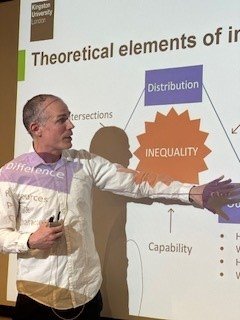
Inequalities in the context of social work and child welfare policy and practice have attracted much attention in research over the last decade. Much of this research has drawn on the techniques used by health researchers to map the social determinants of life expectancy, illness, and other outcomes. However, the study of inequalities in social work and child welfare must take into account the normative and value-based nature of these fields. While evidence of inequalities in child welfare interventions is steadily accumulating, theoretical conceptualizations regarding the mechanisms that underlie it are still in the early stages of development. How then can we address normative, relational, systemic and scientific complexities in research activities? How is inequality, power and social justice understood and conceptualized? How do we incorporate an intersectional approach to our research and develop more nuanced understandings of the field?
This course will examine some of the theoretical and ethical challenges associated with researching inequality in the fields of social work and child welfare. The course will also introduce students to methodological approaches and empirical findings from international studies within the area of child welfare systems.
Learning outcomes
Students will:
– gain knowledge about central theories in the field of social inequality, social work and child welfare
– think critically about researching, such as conceptualization and theorizing inequality and ethical dilemmas, in the context of social work and child welfare
– Gain knowledge on the empirical findings of the international research projects and learn about –the methods used when researching child welfare inequalities
– Gain an in-depth understanding of the following key concepts: social justice, social power, stigma, intersectionality
Learning methods and activities
Lectures, seminars, formative presentations by the participants, and facilitated in-class discussions. The course is taught in English.
Compulsory assignments
Written assignment (4500-5000 words) linked to one issue that deals with theoretical and/or ethical challenges in social work inequality research.
Required previous knowledge
Master’s degree or equivalent
Course materials
General and individually selected syllabus. The general syllabus is announced at the beginning of the course. Deadline for submission of individually selected syllabus is stated at the beginning of the course.
Program
11-13 May, 2026
NTNU, Campus Helgasetr, Trondheim
Course coordinator: Bente Heggem Kojan
Involved staff: Emily Keddel, Anna Gupta, Brid Featherstone, Calum Webb, Mary Elizabeth Hemler, Rick Hood
11th of May – Theoretical perspectives and central concepts
12.00 Welcome and introduction, Bente Heggem Kojan
12.30 What is inequality? Perspectives on child and family welfare inequalities, Rick Hood
13.45 Break
14.15-15.30 What is Intersectionality? Why is it important to think about intersectionality in child welfare research? Anna Gupta
12th of May- Empirical studies – relationship between inequality and child welfare
09.0 –10.00 Researching social interventions with people – qualitative approaches, Anna Gupta
10.00-10.15 Break
10.15-11.15 Researching welfare inequalities – quantitative approaches, Calum Webb
11.15.11.30 Break
11.30-12.30 Researching child welfare inequalities in Norway, Mary Elizabeth Hemler and Bente Heggem Kojan
12.30-13.30 Lunch
13.30-14.30 Domestic abuse, inequality and child welfare services, Brid Featherstone and Rick Hood
14.30-16.30 WORKSHOPS
Parallel workshops with students presenting and discussing abstracts/ideas for essays. Workshops to be lead by involved staff. 2.5 hours (with 30 min break in middle). Appr. four students in each group = 30 mins per student to present.
a. Presentation of case (5 mins)
b. Clarifying questions (5 mins)
c. Discussion (15 mins – presenter listens)
d. Presenter concludes – (5 mins)
18.00Joint dinner for involved staff and PhD candidates
13th of May – Rethinking child and family welfare
09.00–10.00 Strategies for reducing inequalities through community-state partnerships (with comment on settler-colonial contexts but relevant beyond that), Emily Keddell (digital lecture)
10.00-10.15 Break
10.15-11.15 Re-thinking the role of the state and the relationship with child welfare in a very troubled world, Brid Featherstone
11.15-12.00 Summary of the course, led by Calum Webb and Bente Heggem Kojan
Current and future challenges in studying inequality in social work – summarizing reflections and learnings with PhD students
12-13 Lunch